
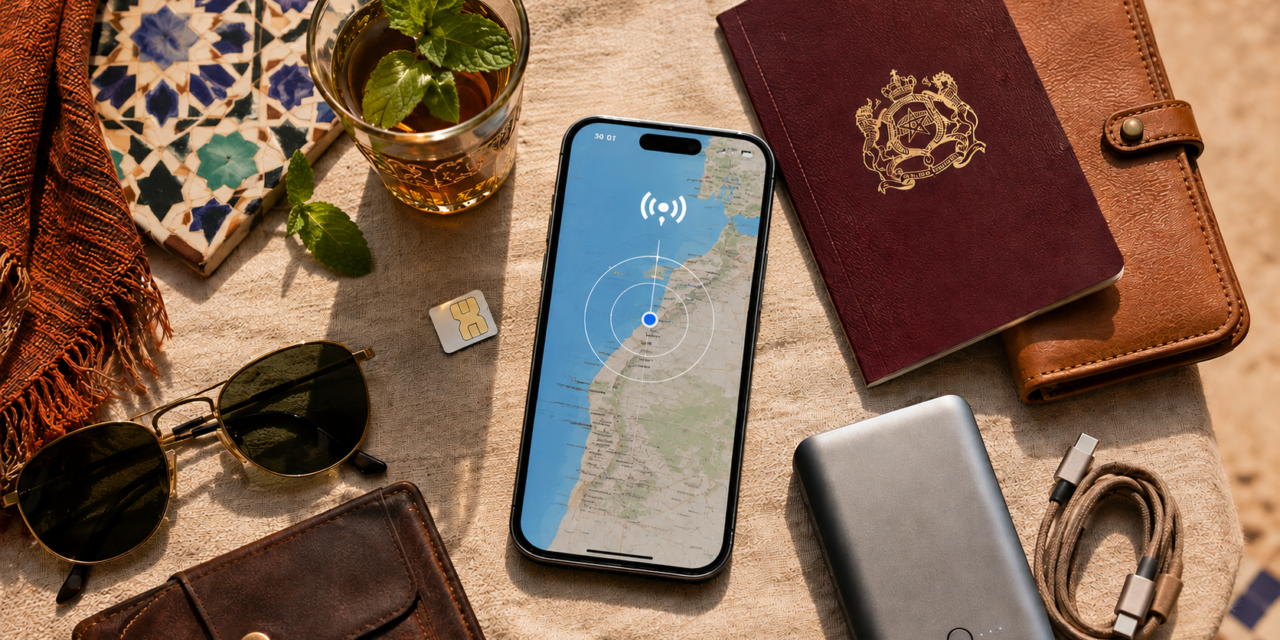
Staying connected during a trip to Morocco makes traveling considerably easier. Mobile internet allows you to use maps, contact your accommodation, confirm transportation, translate unfamiliar words, and stay in touch with your family or travel companions.
Travelers can choose between a physical Morocco tourist SIM card, a local eSIM, an international travel eSIM, or roaming through their regular mobile provider. Each option offers different advantages depending on the length of the trip, the traveler’s phone, and the destinations included in the itinerary.
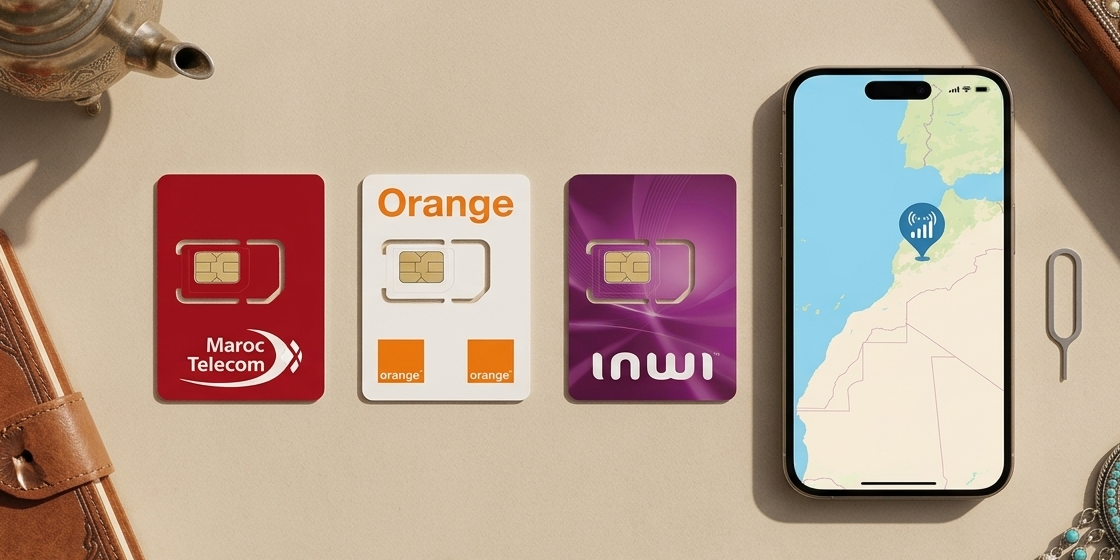
Morocco has three main mobile network operators: Maroc Telecom, Orange Morocco, and inwi. All three provide prepaid mobile data, calls, physical SIM cards, and eSIM services. Coverage is generally reliable in cities and popular tourist destinations, although connections may become weaker in mountains, desert regions, and isolated rural areas.
This Morocco SIM Card and eSIM guide explains the available options, where to buy a SIM card, how much mobile data travelers may need, what to expect from Wi-Fi, and how to remain connected throughout a Moroccan journey.
DO YOU NEED A SIM CARD IN MOROCCO?
A local SIM card is not essential, but it can make a trip much more convenient.
Many hotels, riads, restaurants, cafés, and airports provide Wi-Fi. However, public Wi-Fi is not always fast or available when travelers are moving between destinations.
Mobile data can be particularly helpful for:
- Using online maps and navigation
- Contacting hotels, riads, guides, and drivers
- Ordering transportation in supported cities
- Checking train and bus schedules
- Translating signs, menus, and conversations
- Confirming reservations and opening digital tickets
- Sharing photos and communicating through messaging applications
Travelers who intend to remain mostly inside one city may be able to depend on accommodation Wi-Fi. Anyone planning a road trip, desert tour, or journey between several Moroccan cities will usually benefit from having mobile data.
THE MAIN MOBILE OPERATORS IN MOROCCO
Morocco has three major mobile operators. Their prices are often similar, but coverage and promotions can differ.
There is no single operator that will be the best choice for every traveler. The right option depends on the itinerary, the amount of data required, and the offers available at the time of arrival.
Maroc Telecom
Maroc Telecom, also known as IAM, is one of Morocco’s best-known telecommunications companies. It provides prepaid Jawal lines, internet recharges, physical SIM cards, and eSIM services.
Travelers visiting remote areas often consider checking Maroc Telecom because of its extensive national network. Nevertheless, coverage can still disappear in isolated valleys, mountain passes, and sections of the Sahara.
The company provides a dedicated Maroc Telecom eSIM service as well as visitor eSIM options. Availability, compatible plans, and activation requirements should be checked before purchasing.
Orange Morocco
Orange Morocco provides prepaid physical SIM cards, mobile internet recharges, and eSIM plans. Its services are widely available in Morocco’s main cities and tourist destinations.
Orange allows customers with compatible phones to activate certain eSIM lines using a QR code. According to the company’s official eSIM information, some lines can be purchased online and activated after the QR code is received by email.
Orange also sells prepaid SIM cards through its stores and authorized points of sale.
inwi
inwi is another popular choice for travelers seeking prepaid mobile data. The company provides physical SIM cards, internet recharges, eSIM packs, and specific connectivity options for visitors.
Its official website currently advertises eSIM options for travelers visiting Morocco. Activation normally involves downloading the eSIM profile by scanning a QR code on a compatible phone.
inwi has shops and authorized resellers in numerous Moroccan cities.
WHICH MOBILE OPERATOR SHOULD YOU CHOOSE?
The three operators provide competitive prepaid services, so the decision should be based on the traveler’s route rather than the company name alone.
For a vacation focused on Marrakesh, Casablanca, Rabat, Fes, Tangier, or Agadir, any of the three operators may provide suitable service.
Travelers going into the Atlas Mountains, remote villages, or the Sahara should ask their driver, guide, or accommodation which network currently performs best in that exact area. Local conditions can differ considerably, even between neighboring villages.
It is also helpful to compare:
- Current prepaid data packages
- Length of data validity
- eSIM compatibility
- Coverage along the planned route
- Availability of customer support
- Ease of adding more data
- Whether calls and SMS are included
Coverage maps can provide general guidance, but they cannot guarantee a strong signal inside every building or remote destination.
PHYSICAL SIM CARD OR ESIM FOR MOROCCO?
A physical SIM card is a small card inserted into a phone. An eSIM is a digital mobile profile installed directly on a compatible device.
Both options can provide mobile data in Morocco, but they offer different advantages.
Advantages of a Physical SIM Card
A physical Morocco SIM card may be a good choice when:
- The phone does not support eSIM technology
- The traveler wants a local Moroccan telephone number
- The traveler prefers assistance from an operator employee
- A local prepaid package is cheaper than an international eSIM
- The trip lasts several weeks
The main disadvantage is that travelers may need to remove their regular SIM card. It is important to store the original card in a secure place until the journey ends.
Advantages of an eSIM
An eSIM may be more convenient when:
- The phone supports eSIM technology
- The traveler wants to connect soon after arrival
- The regular physical SIM needs to remain inside the phone
- The traveler wants to prepare mobile data before the trip
- Dual-SIM functionality is required
An eSIM eliminates the need to handle a small physical card. Travelers can often keep their regular number active for messages while using the Moroccan eSIM for mobile data.
However, some eSIM plans provide data only and do not include a Moroccan telephone number, regular calls, or SMS.
LOCAL ESIM OR INTERNATIONAL TRAVEL ESIM?
Travelers can choose between an eSIM sold by a Moroccan operator and an international travel eSIM.
A local eSIM may provide a Moroccan number and access to local prepaid offers. Registration or activation requirements depend on the operator and selected package.
An international eSIM is usually purchased online before departure. It can be easier to install in advance, but its data may cost more than a local prepaid package. Many international eSIMs are also data-only services.
Before purchasing an eSIM, travelers should confirm:
- The phone supports eSIM technology
- The phone is unlocked
- Morocco is included in the plan
- The plan’s activation date
- The amount of mobile data included
- The validity period
- Whether hotspot sharing is allowed
- Whether calls and SMS are included
- Which Moroccan network the eSIM uses
The QR code and installation instructions should be saved somewhere accessible offline.

WHERE TO BUY A MOROCCO SIM CARD
Physical SIM cards are available in several places throughout Morocco.
At the Airport
Morocco’s major international airports may have official mobile operator stands in or near the arrivals area. Availability and opening hours can vary according to the airport and arrival time.
Buying at the airport is convenient because the card can be activated immediately. Travelers should confirm the amount of included data, validity period, and total price before completing the purchase.
At an Official Operator Store
Official Maroc Telecom, Orange, and inwi stores can be found in most large cities. Buying directly from a store makes it easier to compare packages and request help with activation.
An official shop is particularly useful when:
- The eSIM does not activate correctly
- The traveler needs a specific data package
- The phone requires configuration
- The traveler wants a local number
- Additional identity verification is needed
From an Authorized Retailer
SIM cards and mobile recharges may also be sold by authorized phone shops, kiosks, and convenience stores.
Travelers should use a reputable seller, confirm that the line is registered correctly, and avoid leaving a passport or identity document with anyone.
DOCUMENTS NEEDED TO BUY A SIM CARD
Mobile lines may need to be registered to an identified customer. International visitors should therefore be prepared to present their passport when purchasing or activating a local SIM card.
Registration procedures may vary between operators, stores, and online services. The original document should be shown only when required, and it should be returned immediately.
Travelers under 18 should complete any required registration with a parent or legal guardian and use an official operator store whenever possible.
MAKE SURE YOUR PHONE IS UNLOCKED
A phone must normally be unlocked before it can use a SIM card from another operator.
A locked phone may accept only SIM cards issued by the traveler’s regular mobile company. This should be checked before leaving home because unlocking may require assistance from the original provider.
Travelers should also confirm that their phone supports the mobile frequencies used in Morocco. Most modern international smartphones should work, but older or region-specific models may have limited compatibility.
HOW MUCH DOES MOBILE DATA COST IN MOROCCO?
Prepaid mobile data in Morocco is generally affordable. However, operators frequently change their promotions, data volumes, and validity periods.
At the time of writing, small internet recharges commonly start at approximately 5 to 10 Moroccan dirhams. Examples advertised by operators include 500 MB for 5 MAD and approximately 1 GB for 10 MAD. Larger recharges provide additional data and longer validity.
For reference, Maroc Telecom advertises a 1 GB Jawal pass for 10 MAD, while Orange has advertised 2 GB for 20 MAD. inwi also publishes prepaid internet recharge options beginning with smaller daily packages.
These are examples rather than guaranteed prices. Travelers should verify the following before paying:
- Total data allowance
- Number of valid days
- Whether the package includes general internet or selected applications only
- Whether unused data can be carried forward
- Whether the offer renews automatically
- Whether calls and SMS are included
A social-media package may work only with selected applications. Travelers who need maps, browsers, email, or booking applications should purchase a general internet package.
HOW MUCH MOBILE DATA DO YOU NEED?
The appropriate amount of data depends on how the phone will be used.
Light Use
Approximately 3 to 5 GB may be enough for one week when mobile data is used mainly for messages, maps, email, and occasional web searches.
Regular Use
Approximately 5 to 15 GB per week may suit travelers who regularly use navigation, social media, translation applications, and internet calls.
Heavy Use
Travelers who stream videos, upload large numbers of photographs, work online, or share their connection with other devices may need 20 GB or more.
Downloading offline maps, music, entertainment, and travel documents before departure can significantly reduce mobile data consumption.
MOBILE COVERAGE IN MOROCCAN CITIES
Mobile coverage is generally good in Morocco’s principal urban and tourist destinations.
Travelers can normally expect reliable service in locations such as:
- Casablanca
- Marrakesh
- Rabat
- Fes
- Tangier
- Agadir
- Essaouira
- Meknes
- Chefchaouen
- Ouarzazate
Signal strength may still vary inside thick-walled riads, historic buildings, underground spaces, and narrow medina streets.
If the mobile signal is weak indoors, moving toward a window, terrace, courtyard, or open public space may improve the connection.
4G AND 5G IN MOROCCO
The 4G network remains the most practical foundation for mobile internet across Morocco. It is widely available in populated areas and along many important travel routes.
Morocco awarded 5G licenses in 2025, and operators now provide 5G services in supported areas. The ANRT licensing report outlined the introduction and planned expansion of the country’s 5G networks.
By 2026, Orange and inwi advertise 5G-compatible services, while network development continues. Travelers need a compatible phone, an appropriate plan, and access to a covered area. When 5G is unavailable, the device will normally connect to 4G.
Travelers should not expect continuous 5G coverage throughout the country, especially outside large cities.
INTERNET IN THE SAHARA DESERT
Mobile service is available in several desert gateway towns, including Merzouga, Zagora, Erfoud, and M’Hamid. Coverage can become inconsistent after leaving populated areas.
Some desert camps provide Wi-Fi through a mobile router or satellite connection. However, the service may be slow and can be affected by location, weather, electricity, and the number of guests using it.
Travelers should download important information before entering remote desert areas, including:
- Accommodation details
- Emergency contacts
- Offline maps
- Tour operator information
- Tickets and reservations
- Copies of essential travel documents
A lack of internet in an isolated desert area does not necessarily indicate a problem with the SIM card.
MOBILE COVERAGE IN THE ATLAS MOUNTAINS
Network coverage in the Atlas Mountains depends heavily on the valley, village, altitude, and proximity to a mobile antenna.
Towns and larger villages may have good service, while isolated hiking routes and mountain passes can have weak or nonexistent coverage.
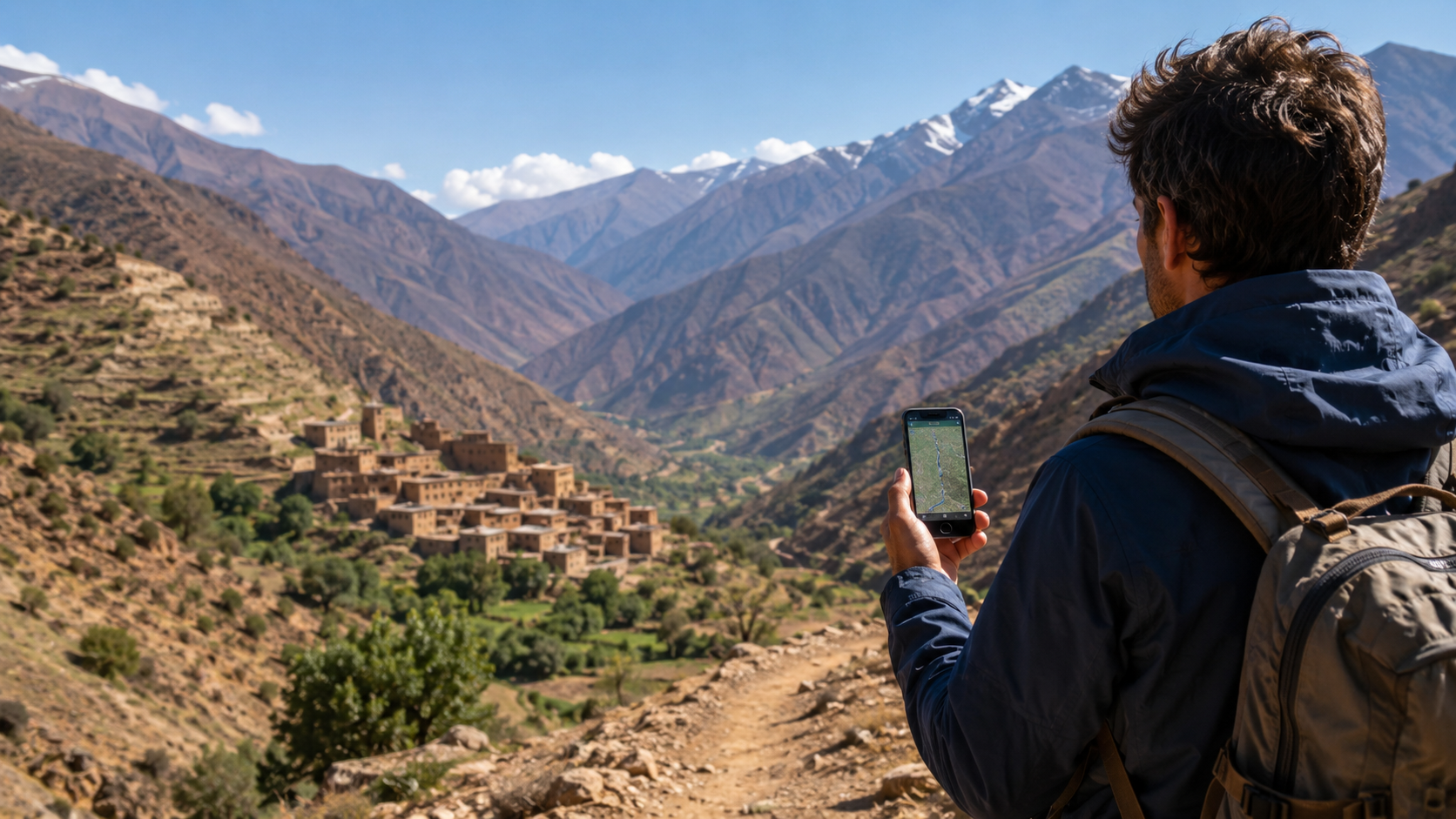
Travelers should never depend entirely on a mobile signal for navigation in remote mountains. Routes should be planned in advance, offline maps should be downloaded, and guided excursions should be arranged with reputable local professionals when appropriate.
Accommodation owners and local guides can often recommend the network that currently works best in their area.
WI-FI IN MOROCCAN HOTELS AND RIADS
Most hotels and many riads provide complimentary Wi-Fi. Connection quality can range from excellent to limited.
Modern hotels may offer strong coverage throughout the property, while traditional riads can have weaker signals inside rooms because of thick walls and inward-facing layouts.
The strongest Wi-Fi signal may be found in:
- Reception areas
- Interior courtyards
- Lounges
- Restaurants
- Rooftop terraces
- Shared workspaces
Travelers who need a dependable connection for remote work or video meetings should ask the accommodation about internet speed before booking.
WI-FI IN CAFES, RESTAURANTS AND PUBLIC SPACES
Many Moroccan cafés and restaurants provide Wi-Fi for customers. Airports, train stations, shopping centers, and coworking spaces may also have public networks.
Public Wi-Fi should be used carefully. Travelers should avoid entering sensitive financial or account information on an unfamiliar network.
Useful precautions include:
- Confirming the correct network name with an employee
- Avoiding unknown networks without passwords
- Keeping the phone’s operating system updated
- Using secure websites
- Disabling automatic Wi-Fi connections
- Logging out of important accounts after use
- Using mobile data for sensitive transactions when possible
Mobile data is often a safer and more consistent choice than an unknown public Wi-Fi network.
HOW TO INSTALL A PHYSICAL MOROCCO SIM CARD
The exact process depends on the phone and operator, but installation normally follows a few simple steps.
- Turn off mobile data roaming on the regular SIM.
- Switch off the phone if recommended by the device manufacturer.
- Insert the Moroccan SIM card into the SIM tray.
- Turn the phone on.
- Wait for the network name to appear.
- Follow any activation instructions provided by the operator.
- Activate the selected internet recharge or data package.
- Test mobile data, calls, and messages before leaving the store.
The original SIM card should be stored in a small, secure container.
If mobile data does not work, an operator employee may need to check the phone’s Access Point Name, commonly called the APN.
HOW TO INSTALL AN ESIM FOR MOROCCO
Before installing an eSIM, the phone should be connected to reliable Wi-Fi.
The usual installation process is:
- Open the phone’s mobile or cellular settings.
- Select “Add eSIM” or “Add Mobile Plan.”
- Scan the QR code provided by the operator.
- Download and save the mobile profile.
- Label the new line as “Morocco” or “Travel.”
- Select the eSIM for mobile data.
- Disable data roaming on the regular home line.
- Follow the provider’s instructions concerning roaming on the travel eSIM.
Some travel eSIMs require data roaming to be enabled on the eSIM line because they connect through a partner network. The customer should follow the instructions supplied with that specific plan.
The QR code should not be deleted after activation. Certain codes cannot be reused, while others work again only under specific conditions.
USING DUAL SIM IN MOROCCO
A dual-SIM phone can keep two mobile lines active at the same time.
Travelers may use their usual number to receive essential messages while selecting a Moroccan SIM or eSIM for mobile data. However, receiving calls or messages through the home line may still produce roaming charges depending on the original provider.
Before traveling, it is helpful to:
- Disable data roaming on the home line
- Select the Moroccan line for mobile data
- Review international roaming charges
- Turn off automatic network switching
- Avoid answering expensive roaming calls
- Confirm which line is used before making a call
The exact settings differ between iPhone and Android devices.
USING WHATSAPP WITH A MOROCCAN SIM CARD
WhatsApp can normally continue using the traveler’s existing account after a Moroccan SIM card is installed.
When the application detects a different SIM, it may ask whether the user wants to change the account’s telephone number. Travelers who want to keep their original WhatsApp number can usually decline the change and continue using the account through Moroccan mobile data.
The original number should remain accessible if future account verification is required. Important conversations and media should also be backed up before traveling.
USEFUL APPLICATIONS TO DOWNLOAD BEFORE ARRIVAL
A few applications can make internet access and travel around Morocco easier.
Useful options include:
- Offline map and navigation applications
- Translation applications with offline languages
- WhatsApp or another messaging service
- The selected mobile operator’s official application
- Airline, railway, and accommodation applications
- Currency conversion applications
- Cloud storage for copies of travel documents
Applications, offline maps, and language files should be downloaded while connected to Wi-Fi.
HOW TO REDUCE MOBILE DATA USE
Travelers can make a small data package last longer by changing a few phone settings.
Consider the following steps:
- Download maps for offline use
- Disable automatic application updates
- Turn off automatic video playback
- Upload photographs only when connected to Wi-Fi
- Reduce streaming quality
- Disable background data for unnecessary applications
- Download music and entertainment before traveling
- Monitor usage through the operator’s application
- Turn off cloud backups while using mobile data
Using hotel Wi-Fi for large downloads can preserve mobile data for navigation and communication during the day.
WHAT TO DO IF MOBILE DATA STOPS WORKING
Connection problems can result from a weak signal, an expired data package, incorrect phone settings, or network maintenance.
Travelers can try the following solutions:
- Turn airplane mode on for several seconds and then turn it off.
- Restart the phone.
- Confirm that the correct SIM is selected for mobile data.
- Check whether the data package is still valid.
- Move to an open area with a stronger signal.
- Confirm the APN settings with the operator.
- Check whether mobile data or required roaming is enabled.
- Contact the operator or visit an official shop.
The eSIM profile should not be deleted unless the provider specifically recommends doing so. Deleting it may require a new QR code.
MOROCCO SIM CARD TRAVEL CHECKLIST
Before departure:
- Confirm that the phone is unlocked
- Check physical SIM and eSIM compatibility
- Compare local and international eSIM options
- Review roaming charges from the regular provider
- Back up important phone data
- Download offline maps
- Save reservations and emergency contacts offline
After arrival:
- Buy from an official or authorized seller
- Confirm the data amount and validity
- Test the connection before leaving the store
- Keep the regular SIM card secure
- Disable unnecessary roaming
- Monitor mobile data use
- Recharge only through trusted channels
FINAL THOUGHTS ON MOROCCO SIM CARDS AND ESIMS
Choosing a Morocco SIM Card and eSIM option is usually straightforward. Maroc Telecom, Orange Morocco, and inwi all provide mobile services suitable for international travelers, with prepaid data available at relatively affordable prices.
A physical SIM card can be a practical choice for travelers who want local assistance and a Moroccan telephone number. An eSIM is convenient for compatible phones and can allow users to keep their regular SIM active while using a separate line for mobile data.
Coverage is generally dependable in cities and major tourist destinations, while connections in the Sahara, Atlas Mountains, and remote rural regions may be less predictable. Downloading essential information for offline use remains important, regardless of the selected operator.
By checking phone compatibility, comparing current packages, and setting up mobile data correctly, travelers can enjoy convenient access to maps, reservations, communication, and other online services throughout their journey in Morocco.

















Recent Comments